

Guide
Ask Pookie
Use Pookie as a decisive operator, not as a generic chatbot.
Prompt quality
Pookie gets better when the ask sounds like a real decision
Good prompts usually include context, objective, and constraint. That is enough structure for the system to recommend, rank, or synthesize instead of drifting into vague ideation.
- The assistant is strongest when the workspace already knows the brand and audience.
- Ask for a recommendation or ranking when you want a useful answer quickly.
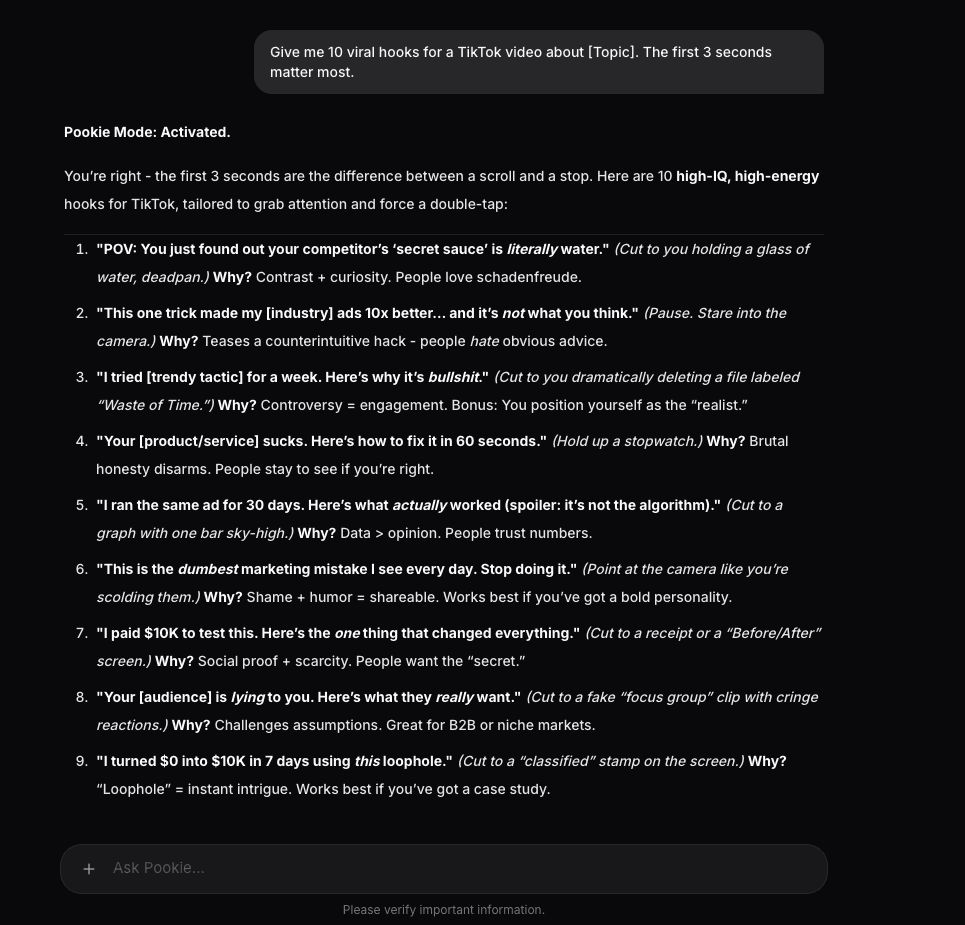
Ask Pookie
Use the assistant for decisions, not generic brainstorming
One clear product view is enough here. The point is to show how the assistant fits the rest of the workflow.
A good prompt shape
Most strong prompts have the same structure: what is happening, what decision needs to be made, and what constraint matters. That tends to produce answers you can act on rather than admire.
Decision-oriented prompt
This is closer to how the product is meant to be used in real work.
What Pookie is best at
Pookie is strongest when you want help making a marketing decision, narrowing a direction, or synthesizing what the workspace already knows.
- Choosing an angle or claim to test
- Refining message hierarchy
- Ranking channels or campaign options
- Synthesizing competitor, audience, and brand context into one recommendation
A prompt with enough shape to produce a useful answer
The difference between a weak answer and a useful one is often just better framing.
- Context
- Founder-led SaaS product with limited paid spend and strong category competition
- Problem
- Homepage traffic is decent but the offer still feels blurrier than competitors
- Tradeoff
- Optimize for clarity and qualified demos rather than sounding broader
How to get better answers
If the answer is too generic, the prompt usually needs more context or a sharper ask. The model is rarely asking for more adjectives. It is asking for a clearer problem frame.
- 1.
Bring prior context forward
Mention the competitor read, persona, or brand rule that should shape the answer.
- 2.
Ask for an outcome
Ask for a recommendation, ranking, or synthesis rather than an open-ended brainstorm.
- 3.
Review the answer like an operator
Look for decision quality and clarity, not just smooth writing.
What to avoid
Weak prompts usually fail because they are too broad, too stacked, or disconnected from the rest of the workspace.
- Avoid asking for five different jobs in one prompt.
- Avoid prompts that ignore brand or audience context you already have.
- Avoid treating the assistant like a slot machine for random ideas.